
From 23 to 30 September 2026, Europe will once again #BeActive. For the twelfth year running, the European Week of Sport invites millions of people – of every age, background and fitness level – to move more, and to move together.
Led by the European Commission and co-organised by national coordinators and sport partners across the continent, it is one of the largest sport-promotion initiatives in the world. Its purpose is simple but urgent: launched in 2015 in response to a worsening physical-inactivity crisis, the Week exists to encourage active lifestyles and to contribute to the health and well-being of European citizens. Its rallying call, #BeActive, is deliberately inclusive – no pressure, no judgment, your way is the right way.
The 2026 edition opens officially in Dublin, Ireland, on 23 September, with the #BeActive Night as its spotlight moment on 26 September. The scale of the movement is best read in its most recent figures: in 2025, the Week’s tenth anniversary mobilised more than 15.1 million people across nearly 80,000 events – in schools, workplaces, parks, clubs and public spaces.
Since 2015, the initiative has reached roughly 118 million participants at over 433,000 activities, evidence that simple, accessible movement can strengthen health, inclusion and social cohesion across borders.
How to Join In
Taking part is easy and open to everyone. You can join a local event through the national coordinating bodies listed on the Commission’s website. Or simply #BeActive your way: take the stairs, walk or cycle a journey, try something new, or get friends, classmates or colleagues moving with you. Every small step counts.
The Making of a European Tradition
The idea of a dedicated European moment for sport was born in the European Parliament. In its resolution of 2 February 2012 on the European dimension in sport, Parliament called for the first time for the creation of a “European Day of Sport” at EU level – the political seed from which the initiative grew. The proposal built on the legal competence the Union had acquired only a few years earlier: with the Treaty of Lisbon, in force since December 2009, Article 165 of the Treaty on the Functioning of the European Union (TFEU) gave the EU a supporting, coordinating and supplementing role in the field of sport, mandating action to develop its European dimension.
Rather than a single day, the European Commission launched a full European Week of Sport in September 2015. The first edition ran from 7 to 13 September 2015 at European level, with national activities continuing to the end of the month, and it was officially opened at the European Sport Village in Brussels by Tibor Navracsics, then Commissioner for Education, Culture, Youth and Sport. From the outset the Week was organised around themed “Focus Days” – education, workplaces, the outdoors, and clubs and fitness centres – and built on existing grassroots good practice rather than replacing it. As a Commission initiative, it was financed at first through the Preparatory Actions in the field of sport and, from 2017, embedded within the Erasmus+ programme.
The Week quickly became a fixed annual appointment. Since 2017 the dates have been standardised to 23-30 September every year, just after the International Day of University Sport (20 September), giving the campaign a stable, recognisable slot in the European calendar. Each edition now opens with a high-level ceremony hosted by a different country and is anchored by the year-round #BeActive brand.
Participation has grown markedly over the editions. The 2024 edition saw around 15 million people take part in more than 50,000 activities – roughly double the number of activities organised the year before. The 2025 edition, marking a decade of the initiative under the slogan “#BeActive – Then. Now. Always.”, was larger still, with more than 15 million participants and nearly 80,000 events across some 40 countries and regions, and a thematic emphasis on replacing screen time with movement for better mental health. Cumulatively, in its first ten to eleven years the Week has grown from a European experiment into a global reference point for active living, mobilising well over one hundred million participants.
Why Awareness Still Matters
The case for sustaining – and expanding – this effort rests on hard evidence. The most authoritative recent snapshot is the Special Eurobarometer 525 on Sport and Physical Activity, based on interviews with 26,578 EU citizens across all 27 Member States in April–May 2022. Its headline finding is sobering: 62% of Europeans never exercise or play sport, or do so only rarely – a figure that combines the 45% who say they never exercise or play sport with the 17% who do so only seldom. Only about four in ten Europeans (38%) exercise or play sport at least once a week, and just 6% do so five times a week or more.
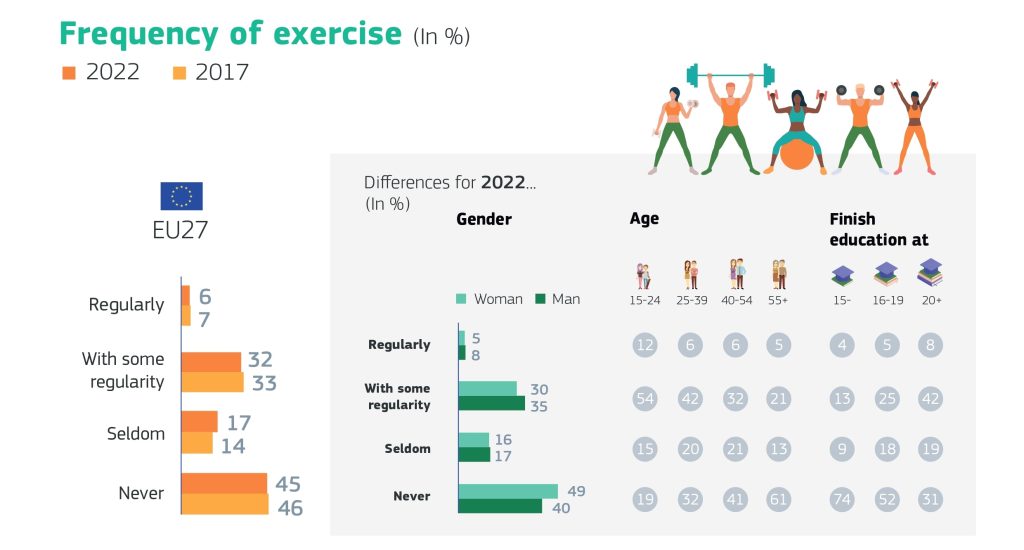
Source : Special Eurobarometer 525 “Sport and Physical Activity” April-May 2022 – Percentages shown are at EU27 level
The longer-term trend is moving in the wrong direction. The share of Europeans who never exercise or play sport has risen by six percentage points since 2009, from 39% to 45%. Sedentary behaviour compounds the picture: 13% of Europeans do not walk for even ten minutes at a stretch in a typical week, and 11% spend more than eight and a half hours a day sitting.
Crucially, inactivity is unequally distributed. Men are more active than women; regular activity declines with age; and engagement is markedly lower among people with less education or in financial difficulty. There are also wide gaps between countries: weekly activity is highest in Finland (71%), Luxembourg (63%), the Netherlands (60%), Denmark and Sweden (59%), while a majority say they never exercise in Portugal (73%), Greece (68%) and Poland (65%). This means physical inactivity is not only a health issue but a question of social equity.

Source : Special Eurobarometer 525 “Sport and Physical Activity” April-May 2022 – Percentages shown are at EU27 level
The consequences are twofold. For individuals, physical inactivity is one of the leading risk factors for overweight, obesity and a range of serious non-communicable diseases. For society, it carries a substantial economic cost – higher healthcare spending, lower productivity, and reduced employability. That is precisely why continuous awareness-raising matters: the survey shows that when Europeans do engage, more than half (54%) do so to improve their health, while the single biggest barrier they report is a lack of time (41%), followed by a lack of motivation (25%). Campaigns like the European Week of Sport are designed to lower exactly these barriers – making activity visible, social, low-cost and achievable – and to keep physical activity on the public agenda year after year, rather than letting the inactivity curve drift further upward.
Policy, Funding and the Tools That Make It Work
Legal foundations. The EU’s role in sport is a supporting one: it complements, rather than replaces, national policy. Article 6(e) TFEU gives the Union competence to support, coordinate and supplement Member States’ action, while Article 165 TFEU sets the substance – developing the European dimension of sport, promoting fairness, openness and cooperation, and protecting the integrity of athletes, especially the youngest. This framework was first given shape by the White Paper on Sport (2007) and its “Pierre de Coubertin” Action Plan – the EU’s first comprehensive sport initiative, which set out goals including strengthening the social role of sport and promoting public health through physical activity – and then developed by the Commission’s 2011 Communication “Developing the European Dimension in Sport.”
The EU Work Plan for Sport is the Union’s central strategic instrument in this field. It concentrates the EU’s main activities and steers cooperation between the EU institutions, Member States and the sport movement. The first Work Plan covered 2011–2014; the fifth and current one runs from 2024 to 2027 and was formally adopted by the Council on 14 May 2024. It is built around three priorities:
- integrity and values in sport;
- the socio-economic and sustainable dimensions of sport;
- participation in sport and health-enhancing physical activity.
The current plan gives new weight to cross-cutting challenges such as sustainability, mental health, digital innovation and accessible infrastructure, and is implemented through structured dialogue, monitoring and thematic (open method of coordination) working groups.
Beyond the strategy itself, the EU deploys a set of concrete instruments to incentivise sport and physical activity:
- Erasmus+ Sport – sport is an integral strand of Erasmus+, which for 2021–2027 allocates 1.9% of its total budget to sport. It funds learning mobility for sport staff, cooperation partnerships and not-for-profit grassroots events. In 2025, sport calls drew around 2,390 proposals (a 34% rise on 2024), with 350 projects selected on a budget of over €67 million.
- The European Week of Sport and the year-round #BeActive campaign – the flagship awareness instrument described above, promoting grassroots participation across Europe.
- The #BeActive and #BeInclusive EU Sport Awards – since 2022 the Commission has recognised achievements in categories such as physical activity, inclusion, volunteering, intergenerational activity and peace, spotlighting both high-visibility projects and grassroots initiatives.
- The HEPA framework – the Council Recommendation of 26 November 2013 on promoting health-enhancing physical activity across sectors (HEPA) remains a cornerstone policy tool, encouraging Member States to embed physical activity across health, education, transport and urban-planning policy. Its possible revision is on the agenda of the 2024–2027 Work Plan.
- Structured dialogue and evidence tools – the annual EU Sport Forum, the HEPA Focal Points network, and instruments such as Sport Satellite Accounts and the Eurobarometer surveys provide the platform and the data on which evidence-based policy is built.
Taken together, these instruments show a coherent logic: a legal mandate under the Treaties, a strategic roadmap in the Work Plan, dedicated funding through Erasmus+, and high-visibility campaigns like the European Week of Sport that translate policy into participation. Keeping the focus on physical activity is not a seasonal gesture – it is a sustained, structured European commitment to a healthier, more connected and more inclusive continent.